
A structural take on Democrats

Application to Democrats before 2020
My last post discussed President Trump from a structural standpoint, so now it’s the Democrats’ turn. I start with a Political Time standpoint. In October 2008 the economy was in the midst of a financial crisis with the stock market crashing and massive numbers of workers losing their jobs. The popularity of then-president GW Bush was in the toilet and Democrats were cruising to an easy victory. Soon-to-be President Obama had a choice, should he play the politics of preemption, as Bill Clinton had done, or should he opt for the politics of reconstruction, as FDR had done? The first choice meant continuing to operate under the political order, or dispensation established by Ronald Reagan. This means Obama should work to restore the economy to its pre-crisis status without making big changes.
For example, the Reagan dispensation held that under the previous Roosevelt dispensation the government taxed the investing class too much and regulated too much. Taxes were cut and certain regulations eliminated such as the ban on stock buybacks. Over 1981-2008 the top income tax rate averaged 40% compared to 80% over 1933-1980. The politics of preemption means honoring the spirit of the other party’s dispensation by not enacting policies contrary to the core values of that dispensation. Honoring the dispensation means preventing steep losses to the investing class and remaining within the established (low) income tax rate structure. Were Democrats to choose the preemptive approach they would ensure the passage of the Bush administration’s TARP bailout bill and not raise taxes significantly.
The second choice would be to try to do what FDR did by changing economic policy to benefit a majority of voters in the hope they will then vote for you. In order to generate the support for such dramatic changes in economic policy, the Democrats would refuse to vote for the TARP, which would likely have led to a market rout and economic crash on the Republican watch. The Democrats would then implement their proposed fix in an environment of panicky demand for action to be implemented in the first year of the Obama administration creating a sharp divide between a Republican before and a Democratic after. This could end in either ignominious defeat or reelection for Obama and a successor, establishing a new Obama dispensation.
As we know, Democrats on 2008 opted for the preemptive route, voting for the TARP and passing a modest stimulus with no tax increases. This is not surprising. Obama was the second Democrat to serve under the Reagan dispensation, making his position equivalent to that of Nixon in the previous dispensation. Nixon had run in 1960 as a fiscal conservative calling for balanced budgets, like Gore did in 2000. Both men lost and were followed by successors who cut taxes, started wars of choice and ran fiscal deficits. When Nixon won in 1968, he left taxes alone and continued to run deficits, and so did Obama. It was too early for a Reconstructive challenge to the existing dispensation.
The situation in 2020 was quite different. It was now 40 years since the start of the Reagan dispensation, and President Trump had already attempted to form a new dispensation of his own and had failed to win reelection. The time was ripe for Democrats to play the politics of reconstruction to try to establish a new dispensation favoring their side. Since Trump is now president, obviously Democrats failed to do this and now it is Trump’s turn.
How to classify the Biden administration
A major crisis had depressed the economy and employment in 2020, which the Trump administration addressed with a large debt-financed stimulus. At the beginning of Biden’s term, there was a groundswell for more stimulus, which the Biden administration enacted with the American Rescue Act and Infrastructure Act, both passed in 2021. These were good laws for the Democrats. The first was very popular and is believed to have played a role in electing Jon Ossoff and Raphael Warnock to the Senate, giving Democrats the majority needed for its passage. It also seems to have played a role in the recent decline in crime rates. The second law has led to tangible improvements to roads and other infrastructure that has been visible to me in the form of a very large number of road construction projects where I live and replacement of aging water lines in my own neighborhood.
This $3.2 trillion of new spending provided an opportunity for enacting FDR-style tax increases to counter the inflationary consequences of all that stimulus. Such tax increases would be attached to the first, highly popular, stimulus bill in order to make it difficult for Democratic senators to oppose. This was not done, making these two initiatives fiscally-irresponsible policies completely in line with the fiscal irresponsibility that is a core part of the Reagan dispensation. As inflation rate was climbing in 2022, Democrats passed the Inflation Reduction Act which was a combination of relatively small tax increases not involving any changes in broad rates with spending mostly on green energy projects that roughly balanced the revenue increase. Since spending and revenue were balanced no inflation reduction would be expected. Its title was a lie like most Trump Administration communications, showing that Democrats were emulating this aspect of the Republican dispensation as well.
Democrats also passed laws to address various smaller-scale issues such as veteran’s health, gun control, Postal Service reform, medical marijuana, and gay marriage. The Biden administration also issued executive orders relating to DEI in the Federal Workforce, racial equity in government programs, trans equity in government programs, and established the Gender Policy Council. Both the legislation and presidential orders mentioned above was about providing deliverables to specific constituencies, much as President Trump took (deserved) credit for making state abortion bans possible in his first term and has dramatically reduced unauthorized migrant crossing of the US-Mexico border in his second. It would seem the Biden administration was playing the politics of preemption, staying within Republican norms on economics while pursuing a variety of social policy objectives. Democrats now mirror Republican fiscal recklessness and dishonesty, as well as their neoliberal policy preferences, while throwing red meat to their gender and racial equity constituencies, much as Republicans do with their nativist, religious right, and anti-queer voters.
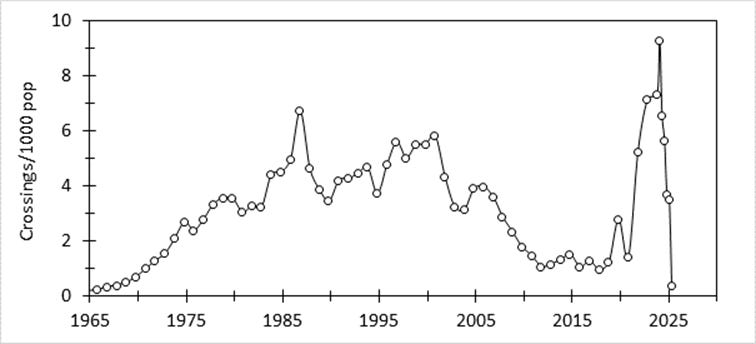
But there was one exception to this. Unauthorized migration across the southern border dramatically increased under Biden, a 350% increase to about two million entrants annually over four years. It wasn’t the sheer number so much, more migrants had crossed over during the Clinton term and a similar number under Bush, but the increase over recent levels. The high levels of the 1990’s and 2000’s generated a backlash leading to lower flows under Obama and Trump. President Trump, in particular, had made this issue the centerpiece of this 2016 campaign and his administration, greatly raising its salience. For Biden to oversee a return to nineties levels of illegal migration was not consistent with the politics of preemption. I would expect a preemptive president to keeping crossings at the level they were under Obama and Trump. Perhaps Biden was playing the politics of reconstruction by spearheading a greater openness to immigration. Seen is this light, the executive orders establishing rights for transgender Americans and supporting DEI may have also been an effort to establish a dispensation based on an expanded concept of human rights, such a right to define one’s gender, to live where it made the most economic sense, and for all identity groups to get fair shares of what Americans collectively produce.
But we already knew that opposition to expanded immigration was sufficient to get Trump elected in 2016. Similarly, policies calling for discrimination in favor of minorities were not going to be very popular with the cis white majority. Indeed, polling shows a collapse in Democrats’ favorability under Biden. Trying to establish a new dispensation on these issues seems to be a fool’s errand, and in the end, Biden did not achieve reconstruction and so he must be placed in the preemptive category.
What should Democratics do to set the stage for a new dispensation?
I believe the positive outcomes establishing the dispensations beginning in 1980, 1932, and 1896 were economic in nature, while the policy establishing the Lincoln dispensation was a social issue (abolition of slavery). The dispensations based on economic issues were established peacefully through elections, while the single dispensation based on a social issue was established through large-scale violence. If we are to resolve this crisis in a peaceful fashion it seems wise that it be done through economic means rather than insisting on direct settlement of the social issues dividing the nation.
If Biden’s policy choices really were an attempt to establish a dispensation based on social issues such as expanded immigration and DEI policies, the Democrats’ loss in 2024 shows that these social issues are not the way to go. The pushback the Trump administration is seeing on their immigration policy also suggests that social issues may not be a sound basis for a new Republican dispensation either, though it is really too early to tell.
With these observations it seems prudent for Democrats to consider formulating economic policy potentially capable of creating a dispensation. As an example of such an approach, I proposed a Democratic economic vision for working class Americans, and suggested some approaches I believe are worth considering. These things work over the long-term. A successful transition also requires a short-term strategy, first to ensure the re-election of the Democratic president trying to establish a new dispensation, and then, more critically, that he is succeeded by another Democratic president.
According to the electoral rules, all the first Democrat needs to do is achieve an approval level of at least 50%, something that was achieved by both Clinton and Obama and could have been achieved by Biden if he had not made several unforced errors, such as neglecting to deal with the inflationary fallout from pandemic stimulus that would likely occur during his term and for which he would be blamed. Another was his mishandling of the US exit from Afghanistan. I noted at the time that Biden’s approval numbers began to decline from this point. Ending the wars that Republicans started, but were too incompetent or cowardly to end, would have made a great talking point for reelection. By mishandling the exit Biden lost this opportunity. Finally, the greatest error was allowing the massive influx of migrants to cross the border. I like most Democrats had not paid much attention to the border. Republicans were squawking about it, but they squawk about everything Democrats do. Nevertheless, the numbers of border crossings were available and known to the administration. Donald Trump had been able to win in 2016 using border crossings as his principal issue and the Biden people were making it eight times bigger. Surely this issue would be that much more potent in 2024?
It was like the administration was sleepwalking. Once again I discounted Republican claims of Biden having lost a great deal of mental acuity in the same way I discount similar claims about Trump. The first debate revealed they were right, the president had lost it, and, hence, the election, and with it any hope for a Democratic dispensation beginning in 2020.
Assuming Trump fails to establish a Trump dispensation or an American autocracy, Democrats will get another chance to establish a dispensation in 2028. To do this they need to raise their popularity. First thing to note is many of the ideas presently popular with progressives are electoral losers. In a previous post, I argued that progressives need to drop Marxism. Aside from the failures of revolutionary efforts to operate national economies according to Marxist principles (e.g., USSR, China pre 1979, N. Korea, Cuba), the theory itself is invalid and its moral philosophy has been resolved into liberal egalitarianism.
Given this I suggest leftists abandon Marxism and get on board with New Deal capitalism (SC economy), a real system that produced a better outcome for the working and middle classes than that obtained under the classical liberal (CL) economy before it or the neoliberal (SP economy) afterward. I propose that the difference between New Deal and Neoliberal economies is cultural. The former ran under stakeholder capitalism (SC) and the latter under shareholder primacy (SP). Figure 1 shows that the SC economy that New Deal policy created gave the best performance as well as the most egalitarian outcome.
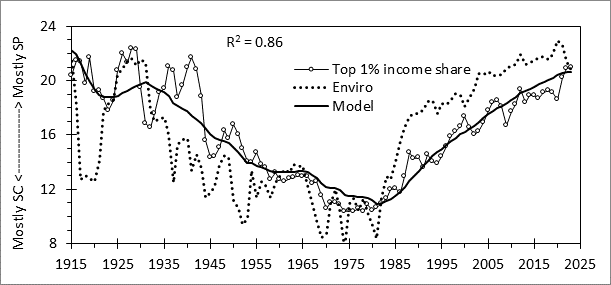
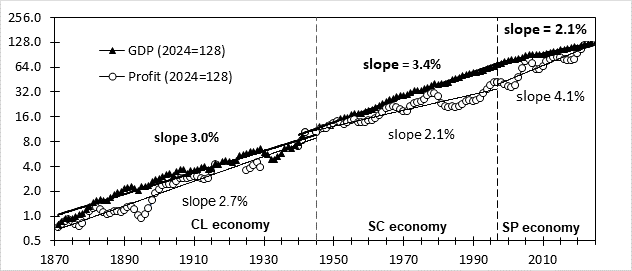
Figure 1. GDP and profit growth rates during successive economies.
Thus, rather than seeking to overthrow capitalism to replace it with some pie-in-the-sky socialism that has never been demonstrated at national scale, why not accept that capitalism, properly managed to give rise to SC culture, gives the best economic deal for the most Americans. It is important to stress that by the SC economy I am not talking about social democracy in the sense of greater income redistribution applied to existing neoliberalism, but to change economic policy (mostly tax rates, inflation control strategies and eliminating stock buybacks) to produce an economy that naturally generates a fairer economic result that requires less redistribution.
With a fairer economy, the leftist resistance to ideas like those promoted under the Abundance movement should dissipate. To some on the left the Abundance proposals seem akin to allowing neoliberalism to run wild in the hope that some good can come as a side effect. Under SC (stakeholder) culture abundance proposals generate a higher yield of positive outcomes for working people. This is why mid-century “sewer socialists” were such strong supporters of development. Development did produce negative externalities like pollution, but it also generated shared material prosperity, all social classes benefited. Working people saw much stronger wage growth while stock market investors got good returns, though not as good as under neoliberalism.

I also suggest that Democrats rethink their stance on immigration, taking the perspective of working-class Americans into account, both potential economic and non-economic effects on them and their clearly expressed opposition to unrestricted immigration. Historically, when the fraction of foreign-born Americans reaches levels approaching those today, reactionary sentiment has developed, sentiment that today feeds the MAGA movement, with all of its ancillary detriments. Democratic immigration policy in opposition to this sentiment is a recipe for electoral defeat and is counterproductive towards the goal of a Democratic dispensation.
Finally, progressives need to consider the electoral consequences of many recently adopted ideas. As I previously wrote, positions on trans rights, black lives matter, and identitarian disability activism are examples of progressive ideas that are both wrong-headed and alienating to most Americans and can serve as a drag on their electoral prospects, making achieving a dispensation impossible.
The reason for these positions is understandable. We are in the midst of a creedal passion period (CPP). Radical new ideas flourish during CPPs, not only on the left, but also on the right because of the absence of the moderating influence of people who experienced the last CPP. The success of progressives seeking social change depends on who holds the dispensation. Radical progressive ideas made significant progress through the various civil rights campaigns during the last CPP (1963-78) because this fell into the Democratic FDR dispensation which was friendly to such efforts. In contrast, the economically left ideas during the CPP before that (1913-27) did not go over so well because that CPP happened during the Republican McKinley-Roosevelt dispensation. Those who advocated for these ideas were called progressives, like today’s left. Yet Roosevelt, himself a progressive, eschewed the label, renaming it liberalism, because of the negative connotations attached to it.
Today’s progressives are in the same boat as those of a century ago. It is time to put away their progressive hobbyhorses and work to build a new “New Deal” for the country that will make such long-term progressive goals as universal health care politically possible. What I have proposed so far are things that should make it possible for a Democratic president elected in 2028 to win reelection, though they still need to do a reasonably good job at governance.
More is needed to achieve the third term victory cementing in the dispensation
What they will not do is ensure the election of a third Democratic presidential term, which according to the electoral rules can only happen if the party has the dispensation. Past experience shows it was sheer luck that granted the 1980 and 1896 dispensations. The 1970s were a time of high inflation and frequent recessions. Reagan was elected, inflation went away and we had a long economic expansion reminiscent of the sixties. This dramatic economic improvement was credited to Reagan and the choice in 1988 was do you want to continue on the path we were on or go back the bad old days of the seventies? The change was palpable, and people voted accordingly.
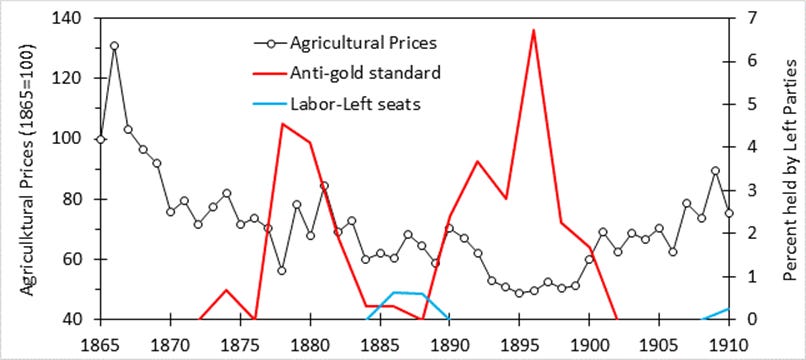
The same sort of thing happened with McKinley-Roosevelt. A long-standing issue before the 1896 critical election had been persistent deflation due to adherence to the gold standard, leading to calls for a more inflationary policy (bimetallism). McKinley was a staunch gold supporter, and it would seem that the deflation would drag on. Then gold was discovered in Alaska in 1898, and the subsequent expansion of the money supply eliminated the problem. The economy surged, the stock market soared to unprecedented highs taking Republican political fortunes with them.
It is unlikely that some external factor will intervene in American politics in the near future to grant a freebie dispensation. Democrats will have to enact dispensation-creating policy. The comparison between FDR and Obama is instructive. Both men inherited a severe economic downturn from their Republican predecessor. Obama succeeded to restoring prosperity and was punished electorally for doing so. FDR did not and was rewarded with a dispensation. The key factor, it seems was real wages. Under FDR hourly wages for working people went up a lot, despite high levels of unemployment, while wages did not rise significantly under Obama. FDR made sure that his administration got the credit for this change in working-class economic experience through signaling and his fireside chats.

Democrats need to enact some sort of policy that makes a rapidly realized positive effect on American’s lives, so they can contrast how it is now versus how it was before—when the other guys were in charge. This is easiest to achieve in the context of an economic decline beginning under the previous administration. If my argument that SP culture makes financial crisis more likely is valid, there is a possibility that with the economy becoming majority SP in the 1990’s (see Figure 1) that we have returned to a period like that before the New Deal when financial crises were a repetitive phenomenon. If this is true, then from the start of the nineties bull market in 1990 we should expect to see a series of semi-regular financial crises. Prior to the New Deal these crises defined a cycle of length 18 years and standard deviation of 3 years. The first of these crises did indeed occur 18 years after 1990, with the next one “due” this year. Given the variance in length, I estimated a 67% probability of such a crisis occurring during the present administration, compared to a basal probability of 14%.
This is a lot of assumptions, and it is more likely this argument is wrong than it is right. If no such crisis happens the task becomes much more difficult. Another possibility is an inflationary crisis, perhaps resulting from a decline in the value of the dollar reflecting a move away from the dollar as a reserve currency. In this case, engineering a sharp drop in asset prices through tax increases and other policy might be a way to address rising inflation (and establishing some of the policies needed to evolve SC culture as a bonus). Higher taxes would reduce deficits which should have an anti-inflation effect. Free-falling asset prices might reduce inflation through expectations.
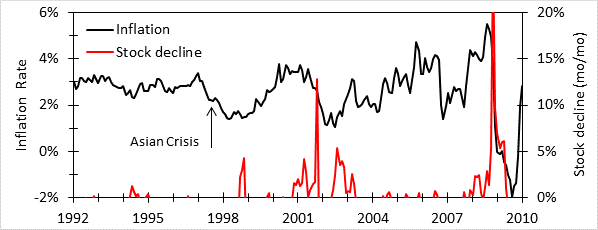
Figure 2. Inflation and S&P500 mo/mo decline (values exponentially smoothed with 0.3 factor)
Figure 2 shows a plot of inflation rate and stock market declines from the previous month over 1992-2010. We see a decline in inflation following the Asian crisis of 1997. This crisis did not produce a significant stock market decline outside the single day minicrash that was rapidly remedied. It did result in a crash in the prices of Asian imports as well as a flight to the dollar that boosted its value, which had a deflationary effect on the American economy. The following year saw the Russian crisis and the Long Term Capital Management debacle, which led to a financial bailout to avoid a wider crisis. This event roiled the stock market to a much greater extent and shows up even in the smoothed data. There was no impact on inflation, however.
The 911 terrorist attack led to a major decline in the stock market, which appears as a sharp spike in Figure 2. This spike was presented in its unsmoothed form in order to highlight the dating. A decline in inflation is apparent from this point. The economy was already in recession at this time, but there had been no impact on inflation until September 2001. Finally, there is the massive spike in October 2008 following the collapse of Lehman Brothers the previous month. Again, a recession was already underway that had had no impact on inflation up to this time. This event greatly accelerated the economic decline and produced a strong reduction in inflation.
This analysis suggests that a stock market decline by itself, even a large one, does not seem to produce falling inflation. Some additional factor such as a financial crisis or exogenous event like 911 that translates the financial decline into an economic decline seems to be necessary. Of course, a deliberate attempt to drive down asset prices has never been tried before, anti-inflation policies have favored measures that adversely affect workers rather than investors, so it is not clear how such an attempt would affect inflation. Other scenarios can be imagined but will not be considered here.
In conclusion, the task of establishing a Democratic dispensation is a challenging one. If neither party establishes a dispensation, the parties will continue to trade off presidential terms as they have been doing until one of the players decides to do away with democracy and use the dictatorial powers this confers to eliminate the political opposition, resolving the secular cycle crisis—or trigger a civil conflict that will do the same.