
Can there be a New Deal that comes from the right?

In this post I consider the prospect for a new economic regime that works for ordinary Americans emerging from the political right. Before proceeding I need to defined some of the terms and concepts I will use to answer this question.
Some preliminaries
What is the working class? I see members of the working class as people who work for others, either as employees paid an hourly wage, or on the basis of task completion such as fruit pickers, commission-compensated salespersons, Uber drivers, etc. For political analysis I use voters without college degrees.
How are working class economic prospects measured? I use an unskilled wage measure as a working-class earning proxy for periods before 2000, which came from Measuring Worth. I use this measure because it extends back to colonial times. permitting analysis of long-term changes. For recent analyzes I use usual weekly earnings of high school dropouts as a measure for unskilled wages. This wage series provides an estimate of the behavior of the market rate of entry-level wages over time. This labor market is fairly liquid in that employers tend to see lots of turnover and are usually hiring. The next higher tier of jobs must pay a premium to this wage, so their wages are directly impacted by changes in this basal wage. As one moves up to higher wage tiers this effect dissipates.
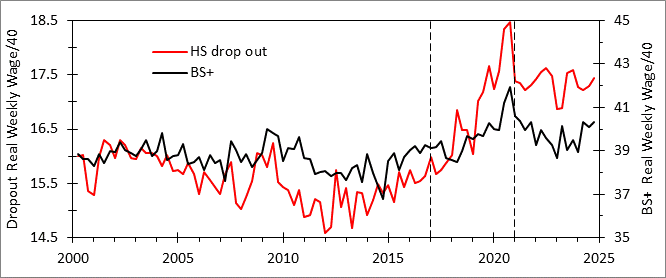
This wage is a proxy for, not a measure of typical working-class wages. A proxy is intended to show how something changes with time, not what the actual value was. For example, this figure shows how during Trump’s first term unskilled wage rose from 40 to 43 percent of college-educated earnings but did not further rise under Biden. That is, the working class (or at least its lower end) gained relative to educational elites when Trump was in office, but not when Biden was, which I interpret as a positive outcome of the first Trump administration for working class voters. I submit this played some role in the low economic grades working class voters gave to Biden relative to Trump.
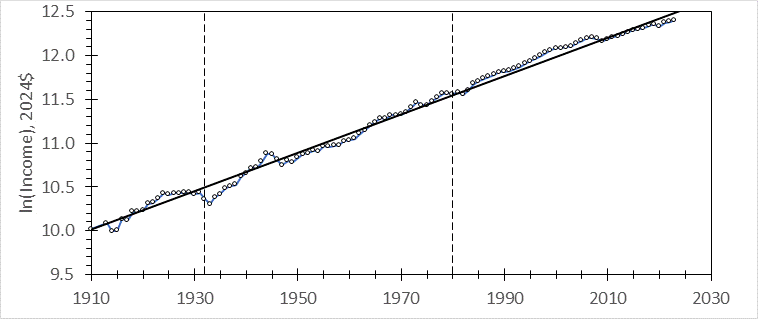
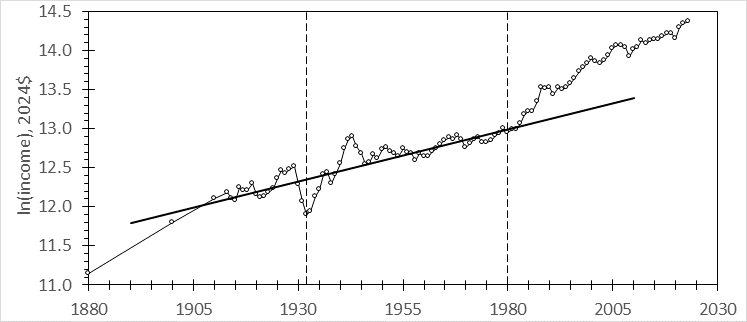
Another economic measure is the share of income received by the working class relative to others. Here working class is considered to be people earning incomes below the median. An example is this comparison of how the working class, affluent, and rich fared economically over the past century. The working class gained a great deal economically during the New Deal era (1940-75) relative to before and after, while the rich did worse. The affluent fared about the same before, during, and after. This experience was reflected in working class voting behavior as I discuss here.


Characterization of cultural politics: I use the terms Red and Blue to represent cultural differences between two “tribes” of Americans. I use these as one axis in a two-dimensional political mapping based on the more familiar Nolan chart as described here. Red tends to be rural, strongest in the South or Mountain West, and socially conservative, while Blue tends to be urban, Northern, Eastern, or West Coast, and progressive. These characteristics go back to the beginning of the country. Today Red is Republican, but in the past it was Democratic. Similarly, Blue was once Republican, but now it is Democratic. So, while these cultures today are used interchangeably with party this was not always the case. When I was young there were still some Blue Republicans and Red Democrats.
The distinction between Red vs Blue culture and Republican vs. Democrat is a key concept for this post. An illustration of distinction it seem in the 1896 and 2012 election. This electoral map of the 1896 critical election shows Republican McKinley winning the Northeast (and the west coast) with Democrat Bryan winning the South and West. Compare that to this electoral map of the 2012 election. The Blue Republican-voting regions in 1896, are similar to the Blue Democratic-voting regions in 2012, as are the Red-voting regions. The political culture did not change, the party representing that culture changed.

How party serves as a third political dimension: The Republican party at its birth was a combination of former Whigs, Abolitionists, the Free Soil Party, and the Know Nothings, each of whom contributed to Republican “political DNA.” From the Whigs they got their bias in favor of Business and economic conservatism, from the Abolitionists, anti-racism and support for women’s suffrage, from the Free Soilers, economic welfare initiatives like the Homestead Act and Land Grant colleges, and from the Know-Nothings, anti-immigrant sentiment.
A business preference for more immigration contests with anti-immigrant sentiment. The Whig strain is usually dominant, but when immigration is particularly salient, such as after the 1919-20 Red Scare and today, Republicans will pursue severe restrictions on immigration. Immigration is a party issue, not a Red-Blue cultural issue, Blue Republicans in the 1920’s and Red Republicans today both restricted immigration. In contrast, the contribution from Abolitionists and the Free Soilers is a Blue issue. Anti-racism, women’s rights, and economic welfare programs, once Republican issues, became Democratic ones as the culture shifted.
Why something like a New Deal can address working class economic problems
I previously described how during the late 19th and early 20th centuries, the urban working class experienced a decline in economic status, as proxied by unskilled wages adjusted for economic growth using the GDP per capita (GDPpc), that is analogous to the same thing going on today. This distress led to a rise in strikes and in leftist political parties. Workers’ fundamental problem was resolved by FDR’s New Deal (see reversal in GDPpc-adj wage here) resulting in a Democratic-working class coalition that created the FDR dispensation. I subsequently showed how a new decline in working class economic status began in the late 1970’s due to changes in economic policy from that which benefits workers to policies (e.g. tax cuts) that benefit investors. I show that with the decline in working class status has come a reduction in their electoral support for Democrats, which one might interpret as a response to breaking of the “contract” Democrats had made with workers under the New Deal.
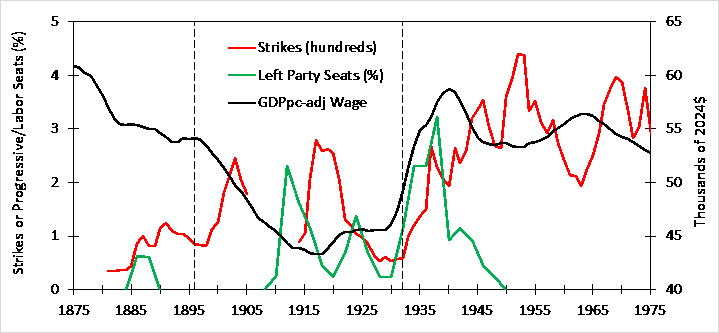
I argue that a political party whose policy reversed the decline in working class economic status, as the New Dealers did, would create a new political coalition with working-class voters. In principle, either party could do this, and by doing so gain themselves a new dispensation and political dominance for a generation.
Could such a “New Deal” come from the Right?
The original New Deal was carried out by the Democratic party, which was the Red party in 1932. Were the Red party to do so today, it would be the Republicans. However, the New Deal was a pro-worker program, stridently opposed by business and economic conservatives. Republicans, as a pro-business, economically conservative party were naturally opposed to it. Republicans have remained pro-business and economically conservative into modern times. In that sense, Republicans would not be interested in doing something like a New Deal.
But the Republicans today are different than those of the Reagan era. It was a triad of pro-business economic libertarians, anti-communist hawks (neoconservatives) and religious, traditional conservatives who established the Reagan dispensation. Things have changed since Reagan’s days. The neoconservatives who rode high in the early 2000’s, have seen their star fall. The pro-business, economically libertarian faction, once the dominant faction, no longer is. Their centerpiece program was the Department of Government Efficiency (DOGE) whose task was to find spending reductions that could be used to pay for the tax cuts this faction most cares about. DOGE was a failure. Nevertheless, the 2017 tax cuts were extended with the 2025 OBBB Act at the cost of more debt.
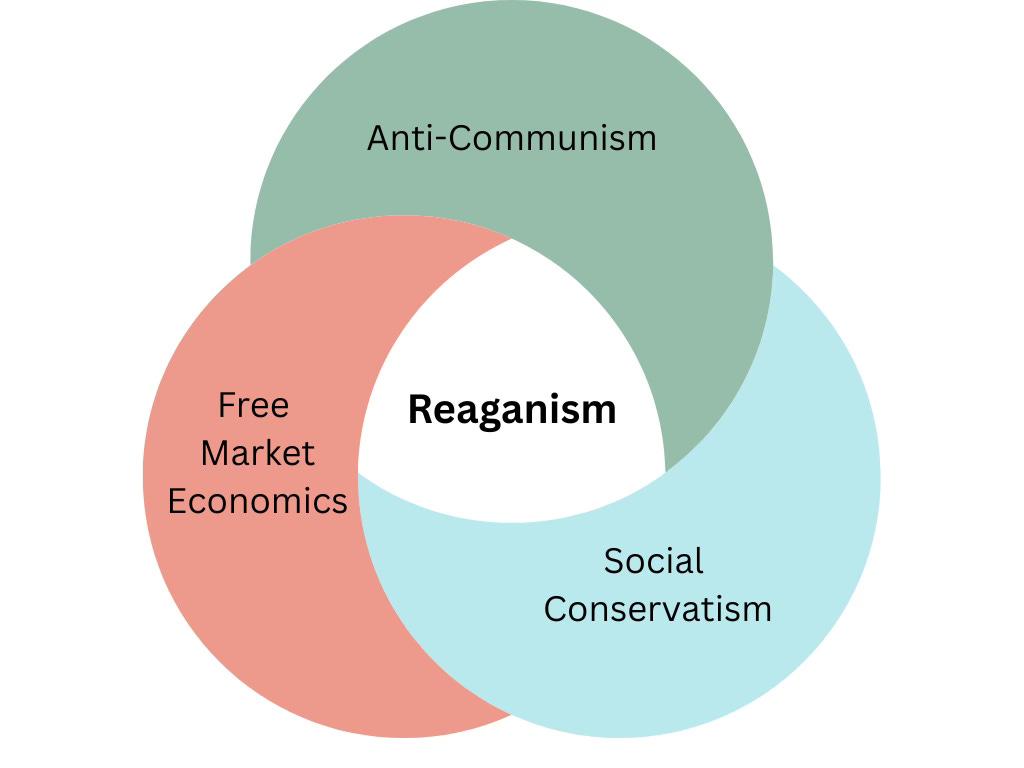
The traditionalists have been the big winner during the Trump administrations. First came the 2022 repeal of the 1973 Roe decision that permitted abortion restrictions in Red states, which was made possible by Trump’s electoral victory in 2016. This was a major deliverable to religious conservatives. High tariffs to discourage outsourcing of American jobs and expansion of funding for immigration and border enforcement to reduce net immigration provided two deliverables to the populist right in the MAGA base.
Edward Campbell describes a new Republican triad as Fortified Borders, Economic Nationalism, and America First foreign policy. The question is whether the economic nationalism leg could accommodate the sort of pro-worker policy I advocate for here, or whether it is still married to low-tax shibboleths of the economic leg of the Reagan triad.
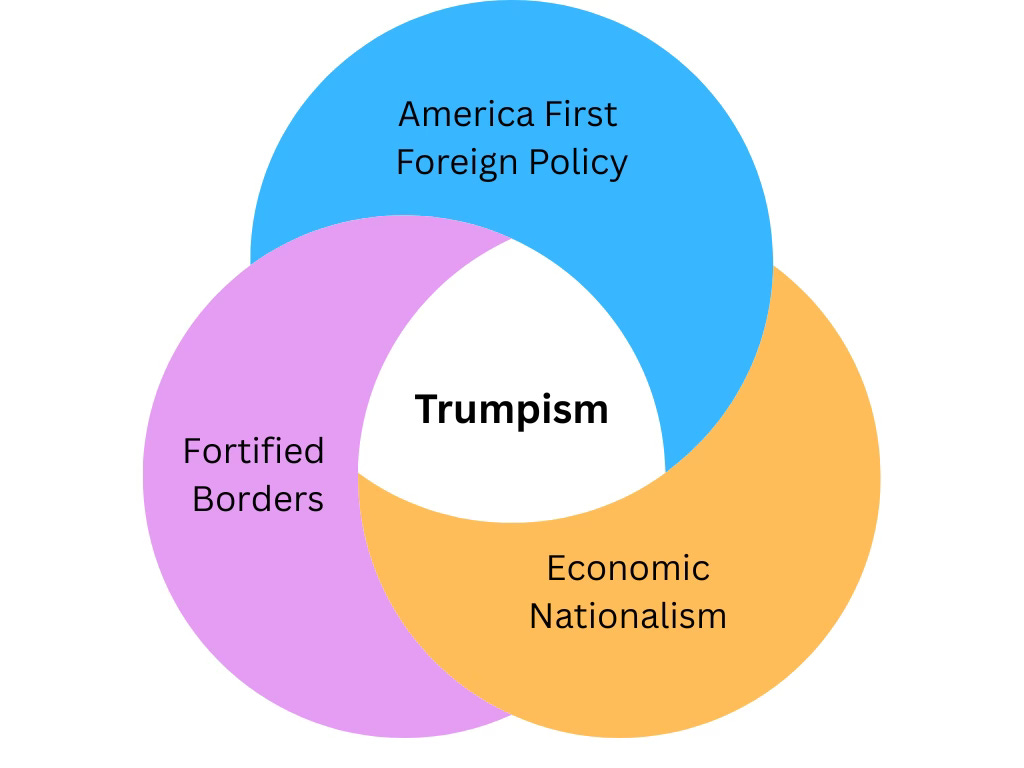
Campbell characterizes this leg as post-liberal. Post liberals seek to redirect the state toward solidarity and the common good through policies such as cash support for families with children, industrial policy, protectionism, and cultural restrictions on pornography and divorce.
Only on the case where the Economic Nationalists claimed the leading role of the new Republican triad (as the economic libertarians did in the Reagan triad) could there be any possibility of a Republican party delivering a trend reversal in GDPpc-adjusted wages like that achieved by the New Dealers during the last secular cycle crisis resolution (1929-1942).
Even if the economic faction ends up dominant it seems unlikely that they would abandon the low taxes on the wealthy policy preferences of the Reagan party and encoded by their Whig political DNA. This would mean shareholder primacy business culture remains in force under which working class wages relative to economic growth (GDPpc-adjusted wage) will continue to fall. Forty years of such decline with increasing numbers of working-class people voting for Republicans has suggests there is no electoral payoff to Republicans for trying to improve economic outcomes for working class people. My initial sense of this is that a New Deal type program to change the economic reality for the working class cannot come from the right.
Why MAGA might be willing to overturn neoliberalism
I use the term neoliberalism to refer to the set of policy choices implemented around 1980 and afterward, which has led to rising income inequality and worse prospects of working-class people. The MAGA movement is, at base, a movement to restore a world when America worked for working-class Americans. A world when an unremarkable young man could have a decent life: get an entry level job, marry, and raise a family. It is possible that MAGA architects are serious about this goal and would be willing to throw business and financial elites under bus to achieve it.
I can illustrate from a personal example what achieving such a goal would look like. When I was 16 in 1975, I got an unskilled job as a park worker, earning the minimum wage, then $2 an hour. There were also adult park laborers who did groundskeeping work who were paid twice as much as I. One of these guys had started as a park worker like me back in 1947, when the pay was 45 cents an hour for my position and 90 cents for his position. That 45 cents in 1947 corresponded to $2.08 in 1975 using Production Worker wages to adjust for inflation/economic growth and $2.03 using the GDP per capita as the adjuster. In other words I was getting paid about the same amount relative to other workers and the overall economy as my counterpart 27 years earlier had been.
But when I make these same adjustments to the present, I obtain corresponding values of $12 and $22. The first figure is close to the $12-14 fast food workers can earn starting out in my area, showing that the production worker series gives an adjustment reflecting reality. But the per capita GDP-based adjustment is very different. Relative to the economy, the $12 an unskilled worker can earn today is lot less than what I earned back then. This tracks with my own personal experience; I put myself through college with no financial assistance from my parents and no debt earning wages like this. My $12-earning modern counterpart can not do this. Had the 1947-75 experience continued, with the entry level worker making $22 instead of $12, I would probably be able to put myself through school today as well.
I noted that the park laborers earned twice what I did—$4, which roughly corresponds to $25/yr and $44 by the two measures. My contemporaries who opted not to go to college would instead take job like that. Had the 1947-75 world continued they would be earning more like $44/hr, some of which would go towards health insurance today, whether provided by the employer or the government. Based on typical premiums without subsidies for families on the ACA exchanges I estimated $11 of that $44/hr figure would be needed to provide health insurance, suggesting that the money income of those laborers in 1947 and 1975 is more like $33 today than $44.
This figure is still $8 higher than $25 such a job would actually earn today. That extra $8 at today’s mortgage rates of 6.7%, would buy about $165K more house. The median home price in 1975, when homes were still affordable, was $39K. Adjusted for inflation with the CPI yields a value of $227K today, suggesting that an affordable home would run about $227. Adding the $165K extra buying power that $8/hr provides makes a home costing $392K affordable. This is 96% of the median price today. So this checks out. Had unskilled workers the same income relative to GDPpc as they did over 1947-75, today’s high-priced homes would be affordable. Working class people have every reason to be angry about economic management by both parties over the past four decades.
This $8hr loss shows the effect of neoliberal economic policy (e.g. tax cuts) since 1980, which has shifted income from working and middle-class workers to elites. Pretax income share earned by the bottom 90% of households has fallen by 13 percentage points to 53%. Based on the $33/hr income I calculated above, this loss corresponds to a loss of $33 x 13/53 = $8 — in line with my example.
The significance of this $8 decline is that a GenZ working-class guy today needs to hustle to obtain higher-paying jobs just to avoid downward mobility in today’s world, while his great grandfather back in 1947 did not. As a result of this downward economic trajectory, a random working-class man in 1947 or 1975 was a better marriage prospect than his counterpart today. I previously explored this in a post analogizing the past and present economies to Bedford Falls and Pottersville from the holiday classic It’s a Wonderful Life.
Restoring this loss would go a long way towards making America great again. Doing so would create a new Republican dispensation and lock in a socially conservative bias in public policy reminiscent of the 1950’s for a generation. This might be how ditching neoliberalism could be fit into the MAGA vision.
But this is a long shot. Though neoliberal policy is no longer the center of the Trump Republican party, there is strong support for the continuation of policy that benefits rich people like Trump while relying on conservative social and cultural policy to secure electoral support, which has worked for Republican elites for more than forty years. In this Republican elites are analogous to Democratic elites who have their own basket of progressive social and cultural policy they employ for functionally the same purposes.
In conclusion, I simply note that there is no fundamental contradiction between pro-worker economic policy and the core tenets of the MAGA Republicans, as there was for the Reagan Republicans. But so far in practice, the MAGA Republicans remain strong supporters of Reagan era neoliberal policy.
Michael, another really insightful and illuminating post. I hadn’t thought about the possibility of a Republican ‘New Deal.’ Is there anything in the Project 2025 plan that points to this sort of scenario?